Frank C / Exploratorium Return

I have just uploaded Frank C’s cases to the willardsuitcases.com site. His things are among the most important in the collection. There is so much to be learned from what he chose to bring with him to Willard, and from the letters he received while there. And he was such a handsome gentleman. Go to the site and click on “The Cases” and scroll down to the bottom of the page. Click on “Frank C” and make sure you click “view all” to see the photos.
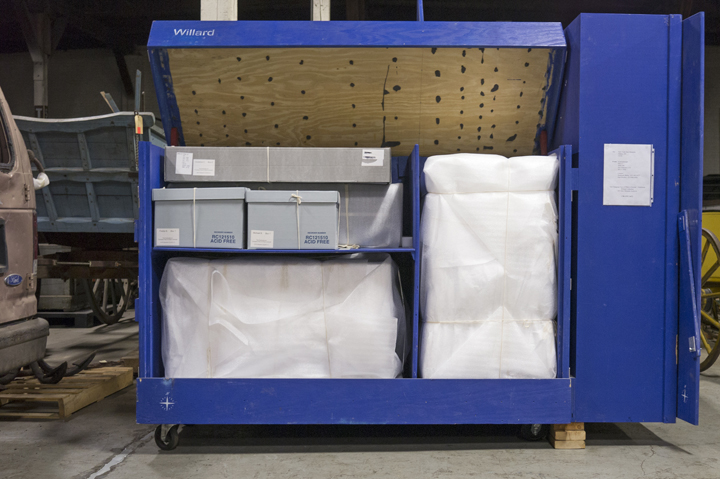
I am so happy that the suitcases that were part of the Exploratorium exhibit have just arrived back at the storage facility. Among them are the last of the cases to be photographed. Yesterday Peg and I, along with museum staff, spent part of the day taking a look at the shipping containers and getting organized.
It has been a very emotional few weeks for me, as we are down to just 6 people left to photograph. It will be the end of over 4 years of shooting, and while in some ways, it is just the beginning of what will happen with the project, I am feeling a strong sense of change and loss.
Thanks for following the project, and for all the support that I receive from this fantastic virtual community.
Willard Tour / Cemetery / Names / Thoughts – Part 2

It was interesting to me to find out that it was OMH itself that tracked down Lawrence Mocha’s distant relatives. According to Mr. Allen, his office used every means possible to locate Lawrence’s family in order to get permission to release his surname, which in turn allowed his full name to be used on the plaque on the cemetery grounds. In my conversation with Mr Allen, he explicitly said that surnames could be released if a representative of the family could vouch that there was no objection to releasing that name. OMH would send documents that would need to be signed in order to guarantee family acceptance, but as in the case of Lawrence’s family, it would not need to be a direct descendent who signs those papers. (Lawrence did not appear to have any children.) This is a huge development for any family members who seek information about relatives that lived in state Psychiatric Centers. Again, massive credit goes to Colleen Spellecy and her group for getting OMH to move on this. It would be naive for anyone to think that any of this would have ever happened without her hard work. What was especially amazing to me was that towards the end of the ceremony, members of the committee read the actual names of over 100 patients who were buried at Willard. And Colleen has a list of 500 more families that have agreed to the release of names.
After the ceremony I had a very nice chat with Anna Kern, whose father’s mother’s maiden name was Mocha, and if I am correct ,was a cousin of Lawrence. She and her husband travelled from Minnesota to be at the ceremony, and Anna was genuinely moved by the fact that people were acknowledging her long forgotten family member. I was also able to introduce myself to Darby Penny whose work on the suitcases preceded my own access to the collection. It was an interesting conversation, as our goals differ greatly, and I believe we have a fundamental disagreement about the role the state played in the treatment of people with conditions that led them to a life at Willard. I think it is very obvious to anyone who views my work vis a vis hers what those differences are. Darby’s book and site are worth checking out if you want to get an idea of her approach to the suitcases.

I was going to write a bit about my feelings of seeing so much attention focused on Willard, but I think I’ll save it for later, as I am still sorting it all out. But I did want to mention something really great that happened as I was leaving to drive home. Several weeks ago I was contacted by Clarissa B‘s niece Christine. She was moved to get in touch after she stumbled across this site and realized that Clarissa was actually her aunt. Somewhere in the comments on that post, someone wrote that it was a shame that people like Clarissa were forgotten. Chris wanted to correct that idea. What she told me was that even as a patient at Willard, Aunt Clarissa spent quite a lot of time visiting her family, especially during holidays. As a child, Chris enjoyed seeing her, and it was important to her to let people know that she was decidedly not forgotten. So just before getting into my car to head home, I read an email from Chris that she had taken the tour and was herself about to leave. We managed to meet on the side of route 132A and have a lovely conversation.
One last thing I want to mention. I am just a photographer who has been given an incredible opportunity to document the Willard Suitcases. Though I have developed strong opinions about what Willard was all about, I work very hard to separate those feelings from my work as a photographer. Mental illness is a hugely complex issue, and ultimately I have no interest in using my work to make a point about what the state did or didn’t do in regards to the people who lived at Willard. I just hope that my photographs can give a little bit of life back to those folks, and allow them to be defined as something more than just people with a mental illness. Thanks to all of you for following along, and giving me such incredible motivation and support.
 Jon Crispin's Notebook
1 comment