Frank C / Exploratorium Return

I have just uploaded Frank C’s cases to the willardsuitcases.com site. His things are among the most important in the collection. There is so much to be learned from what he chose to bring with him to Willard, and from the letters he received while there. And he was such a handsome gentleman. Go to the site and click on “The Cases” and scroll down to the bottom of the page. Click on “Frank C” and make sure you click “view all” to see the photos.
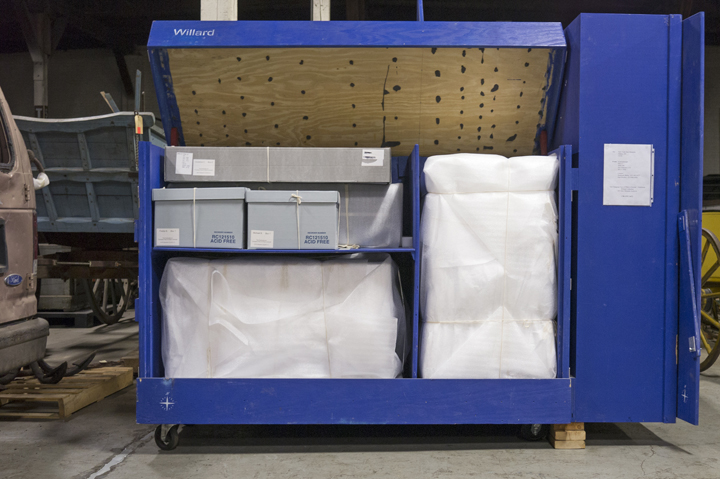
I am so happy that the suitcases that were part of the Exploratorium exhibit have just arrived back at the storage facility. Among them are the last of the cases to be photographed. Yesterday Peg and I, along with museum staff, spent part of the day taking a look at the shipping containers and getting organized.
It has been a very emotional few weeks for me, as we are down to just 6 people left to photograph. It will be the end of over 4 years of shooting, and while in some ways, it is just the beginning of what will happen with the project, I am feeling a strong sense of change and loss.
Thanks for following the project, and for all the support that I receive from this fantastic virtual community.
Willard Suitcases / Back to Work / Flora T
I’ll be back in Rotterdam tomorrow, and am looking forward to shooting again. We are hoping to finish up with Margaret D’s things soon, and once the Exploratorium cases are back from California, that will just about do it.
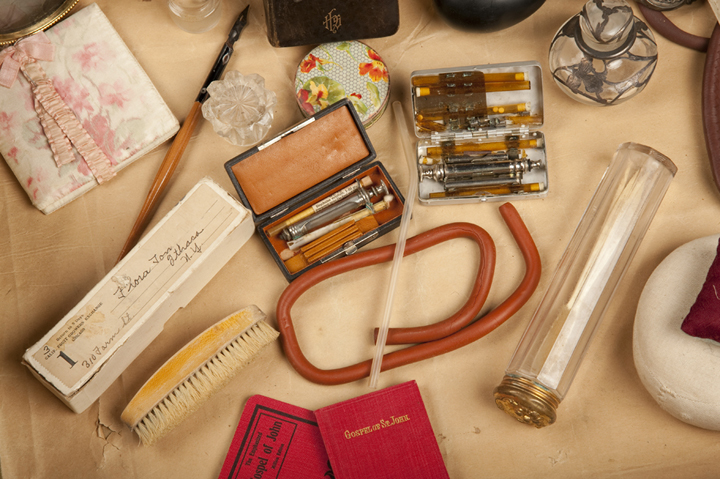
I have just uploaded Flora T’s photos to the willardsuitcases.com site and it is worth checking out. She had some amazing possessions. When you go to the site, click on “The Cases”, select Flora T, and be sure to select view “all” at the bottom of the page.
My friend Lin Stuhler has just put up a few new posts on her site. Well worth checking out. Click here and here.
I hope to post some images from tomorrow when I get home in the evening. Thanks for following.
Willard Tour / Cemetery / Names / Thoughts – Part 1

This year’s tour of the former Willard Psychiatric Center was overwhelming in many ways. (See my post about 2014.) It was clear that the crowds would be large when, about a mile from the site, traffic was completely stopped on Route 96A. I ended up parking in the Grandview lot. Those of you who are familiar with Willard will know where that is in relation to the facility. Someone mentioned that social media might have had something to do with the crowds as there were a lot of Facebook posts going around. There has never been this kind of turnout for a tour.
I had hoped to meet up with some folks who follow this site, but the crowds made it nearly impossible.
My main reason for being there was to attend the ceremony honoring the gravedigger and former patient Lawrence Mocha.

Colleen Spellecy’s group has done an amazing job, not just in pressuring the New York State Office of Mental Health to allow Lawrence’s surname to be used, but in cleaning up the site and uncovering the markers placed in lieu of headstones. Here is a link to her group’s site. I can’t stress enough how her drive and dedication to honor the folks buried at the cemetery made this happen. There is currently a bill before the legislature (S840 / A6386) to allow the release of names of patients, and if you live in New York State, Colleen has made it easy to contact your local representative. Here is a link to the page on her site where you can click to send a message to your rep.
I also want to mention Lin Stuhler’s hard work in pressuring legislators to introduce a bill that would release the names of patients buried in psych center cemeteries. Here is a link to Lin’s site. Anyone interested in her work should buy her book, The Inmates of Willard, which you can order through her site or on Amazon. She could really use your support, as dealing with the state bureaucracy can be a draining experience, and she has really hung in there to move this ahead.
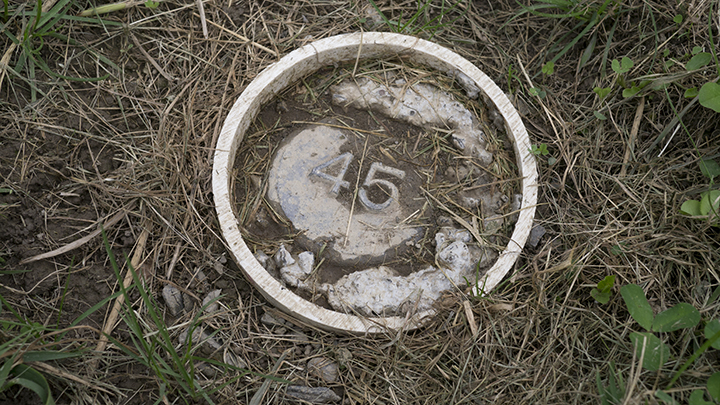
Lawrence’s grave marker was identified by someone who knew its location, so the committee was able to have an exact location of his burial. It was lovely to see groups of people standing near the spot and honoring his memory. Just how this all happened is still amazing, really. I won’t go into a long summary here, as I am not familiar with all the ins and outs. But in a nutshell, Colleen had been working for years to get Lawrence’s name made public. It wasn’t until an article appeared in The New York Times last November that OMH felt compelled to cooperate with her.
This whole naming thing is something that has been frustrating to me and others. I am able to see both sides of the argument, but I am still strongly favor being able to use surnames when talking about the patients. I understand the idea that some shame is attached to those who have suffered from a mental illness, but I feel it is dehumanizing to not identify them. And for families that want to learn more about their ancestors, it is important to be able to access records. I get contacted almost daily by relatives asking if I have photographed a suitcase belonging to a family member.
That being said, it seems that OMH is apparently now more open to providing information about former patients. John B. Allen, Jr, who is Special Assistant to the Commissioner, told me explicitly to post his name and contact information so that family members can learn more about their relatives. The telephone number is 518 473 6579 and his email is John.Allen@omh.ny.gov.
I want to write so much more about this, but I have to run out to check out the historic Pelham Town Hall building, which I will be photographing soon. So I will post this now, and continue with part two in a few hours. I haven’t had time to proof read this, so pardon any typos. I will catch them later.
Willard Suitcases / Margaret D / Update

One of the loveliest aspects of my work on the suitcases is connecting with wonderful, smart, and knowledgable people. After this morning’s post, I received a comment from Dhyan about the photograph. You can read her comment here. (Scroll down to see it.) She seemed to know so much about the subject that I emailed her a full resolution image of this wider shot. Here is her response. I am sure she won’t mind me reprinting it.
Jon, Thanks!!!
I enlarged the picture to 500% and took a really close look at it. Here are some other things I notice.
Top Right: I believe that band was probably done as “draw work” Some of the threads are selectively pulled out and the rest are used to make the patterns using an embroidery thread to hold them in place.
Did you notice how beautifully woven the folded fabric on the right is? You don’t see THAT any more. My grandmothers had some table cloths that looked like that. How they could ever bring themselves to put them on the table with grandkids around is a mystery to me! I do believe they were heavier handed with Clorox in those days!
I noticed at the bottom there is a line that says “Royal Society No 5….” That probably means that she bought this piece of fabric from an embroidery fabric company. Probably the zig zag line was already on the fabric when she bought it but the pattern she would have filled in is above it and probably on other parts of the fabric as well.
The blue edging is crochet. Because the pattern is penciled in or stamped on, I wonder if that was already on the piece when she bought it but maybe not. Still I think I would have done the pattern first and the edging last so maybe it was on there already. She may have been bringing pieces of uncompleted work to do at the asylum.
One more thing. The piece between the blue edging and the left edge piece, that looks like a lace border, maybe the top of a camisole, is tatting. I have actually never seen tatting done but I know you have a kind of spindle that looks a bit like a guitar pick and by going over and under and around the through you make those edgings. Look at the VERY edge that is not crochet which is why I think it is tatting.
The only thing that is a bit bothersome if the green embroidery with the colored flowers. That is not up to the quality of the rest of her work. Wonder what the story is with that?
Anyway, thank you so much for showing it to me. I loved looking at it. People don’t know much about embroidery these days. I once had the opportunity to look at a very, several-hundreds-of-years old embroidered Chinese jacket and spend about an hour pointing out details to the owners. It was silk, Jon, with tinier stitches than I had ever seen.
Anyway, thank you again for a lovely half hour of procrastination! J
Dhyan
Dhyan, I am not sure if you were aware of her history, but Margaret was Scottish by birth and didn’t come to the States until she was a young adult. I would guess that she acquired her skills with the needle before arriving here.
It is a good time for me to thank all of you who are following this project. I really do feel close to those of you who comment, and pay so much attention to this unique collection. Cheers, Jon
Willard Suitcases / Margaret D. / Tour
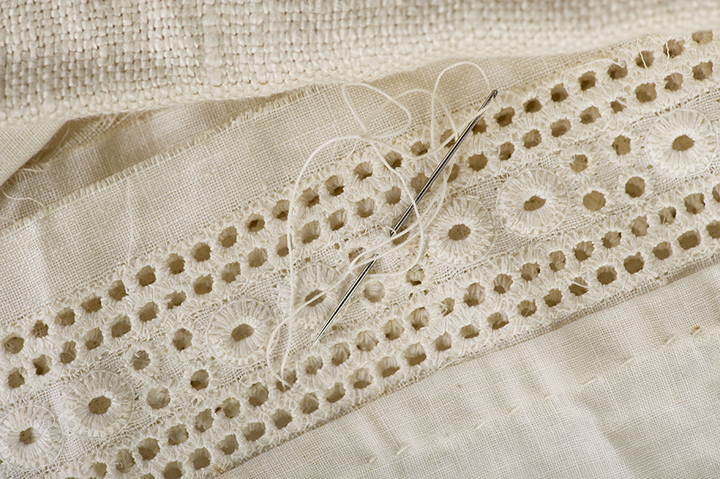
Yesterday Peg noticed some of Margaret D’s handiwork with a needle. And here is one of those needles, still in place where she last used it. I have no idea what this process is called, but it looks quite intricate.
The annual public tour of Willard is on for Saturday the 16th of May. It is a fundraiser for the Elizabeth Cady Stanton Children’s Center. Here is a link to their Facebook page. I would advise getting there very early, as this is a wildly popular event. Tours are run at 9.00 am and 1.00 pm. And if you have never experienced a central New York State chicken bbq, I would advise you to get some tickets for it. Also that day, a memorial service will be held at the cemetery across the street honoring Lawrence Mocha, who as a patient dug many of the graves. That event takes place at 11.00 am and should be interesting.
I will be there for much of the day, and would be most happy if those of you who follow this project would come up and say hello. If former Willard employee Peggy Ellsworth is in charge at the morgue again this year, I will probably hang out with her much of the time.
Willard Tour 2015
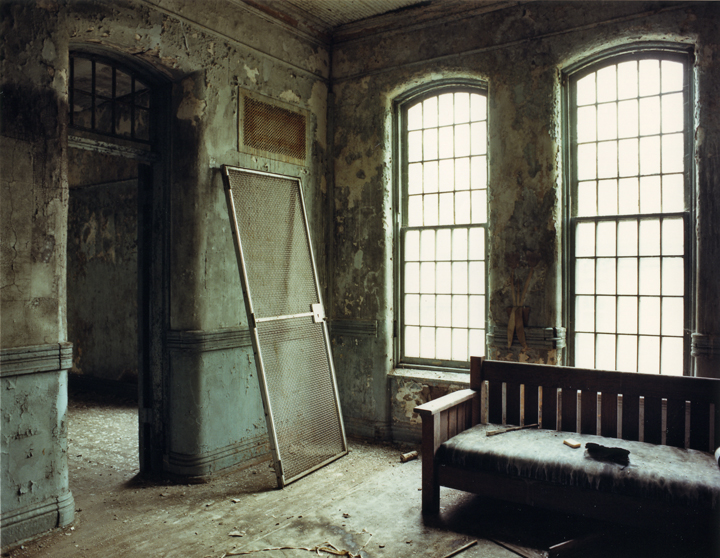
I am often asked about the annual tour of the Willard grounds, and I now have some tentative information about this year’s event. It is a fundraiser for the Elizabeth Cady Stanton Children’s Center, which is on the grounds of the old asylum. Here is a link to their Facebook page, where they will post details. It is tentatively set for the 16th of May. If you plan to attend, get there early as it is usually very crowded.
Additionally, the Willard Cemetery Memorial project is holding an event that same day in honor of Lawrence Mocha. Here is a link to a Finger Lakes Times article that includes some details.
I hope to attend each event, and would be happy to see any of you who can make it. Thanks to Mark for the tip about the Lawrence Mocha event.
The above picture is one I took in May of 1984 on my first visit to photograph inside Chapin House on the Willard grounds.
Willard Tour
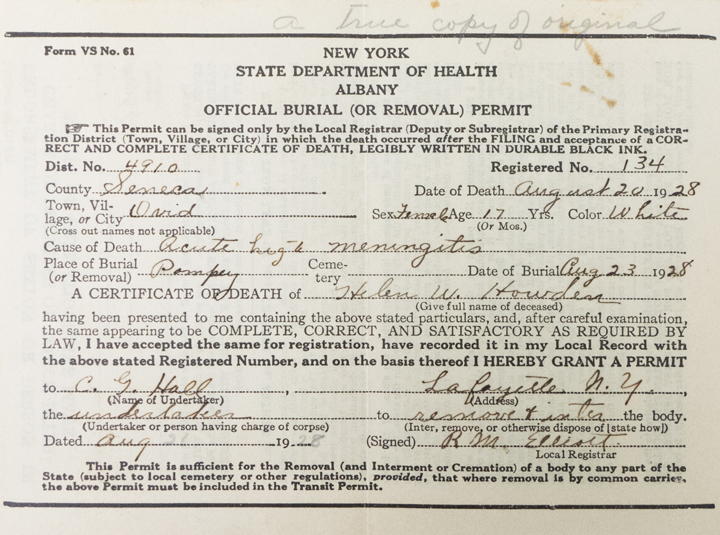
I wasn’t sure I would go to the Willard tour this past weekend until I was recently contacted by Ken Paddock. When Ken told me the story of his aunt Helen who died at a very young age as a patient at Willard, I really wanted to meet him. His family had kept an amazing collection of documents and artifacts related to her death in 1928 at the age of 17. She had contracted a disease (possibly scarlet fever) at a young age which caused blindness and other problems, and she was sent by the family to The Syracuse State School for Mental Defectives. She was transferred to Willard when the State School could no longer control her. The collection contains letters written to the family about her situation, including a letter from the head of the State School advising the family why she would be moved. Ken’s mother rarely talked about her older sister, and it wasn’t until just before her death in 2001 that details about Helen’s institutionalization started to come out. It is amazing to me that these artifacts were saved by the family, especially since it seemed that no one spoke much about her for such a long time. I met Ken, his wife Kathy, and their cousin Carol at the Taughannock Falls overlook on Saturday morning and was shown a binder full of artifacts. They encouraged me to talk about her life, and are graciously allowing me to photograph the collection, which I hope to do later this summer. It is great to be able to use her full name as this collection is in private hands and does not come under the state’s control. So, here’s a kind thought for Helen W. Howden, and thanks to Ken’s family for sharing her story.
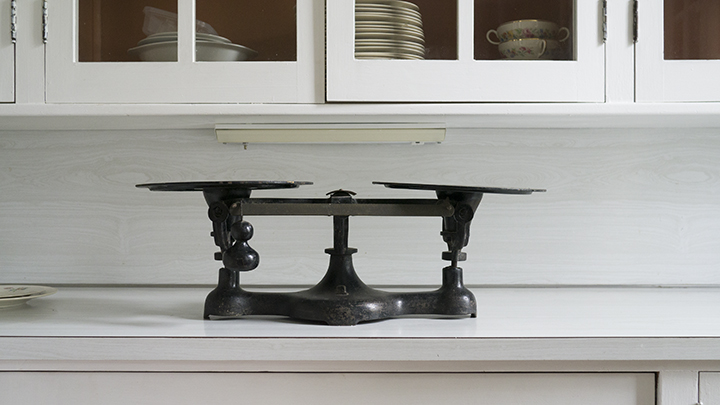
We got up to Willard at around 12.45 and were organized into groups for the tour. The first stop was Brookside, which is where the medical director and his family lived. It is a lovely early 20th Century house and situated right on the shore of Seneca Lake. As usual I was drawn to one of the three kitchens and took a few shots before I headed downstairs.
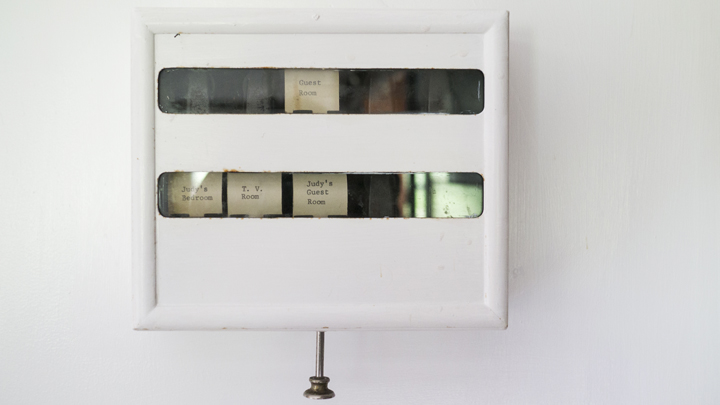
This device was used when the family wanted to request something from the staff. When Craig Williams and I were looking at it, the buzzer sounded when another member of the tour pushed a button in one of the upstairs rooms.

Next stop was the game room in the basement. I am not sure which director’s family would have used this foosball table, but it was most likely Dr. Anthony Mustille’s children.

Since I had already been in several of the buildings on the tour, Peggy Ellsworth suggested I come over to the morgue when it was between groups. She is one of the main boosters of Willard’s past, and spends a great deal of her energy keeping the spirit of the place alive. She told me an amazing story of her first day on the job after she had graduated from the nursing school. It involved her first autopsy when she was standing right where she is in this photograph.

It constantly astounds me that evidence of how these rooms were used is still in place decades after Willard’s closing.
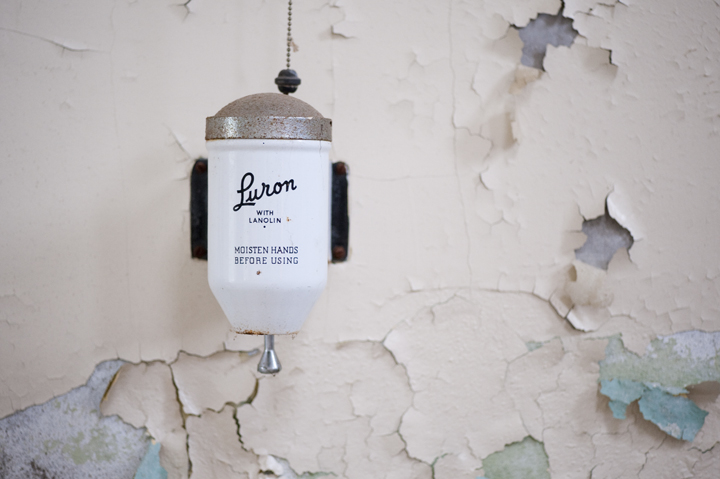
The morgue building is a tiny little brick edifice that I had never been able to get into on my earlier visits.

So many interesting aspects to this room.

This is the faucet at the head of the autopsy table.
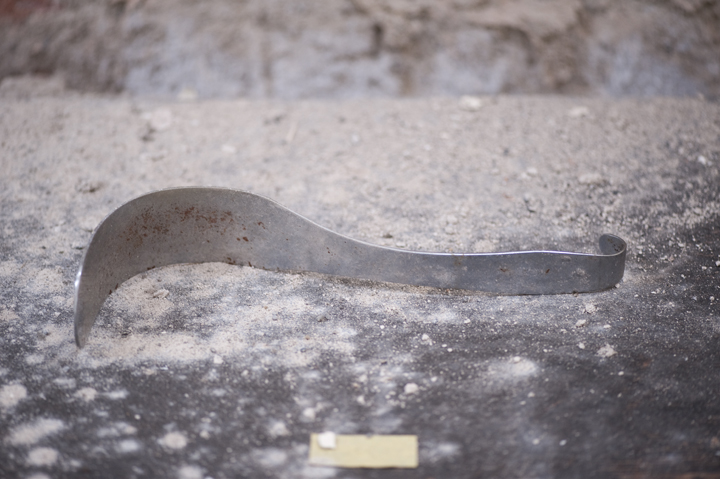
And who knows why this retractor was left behind?
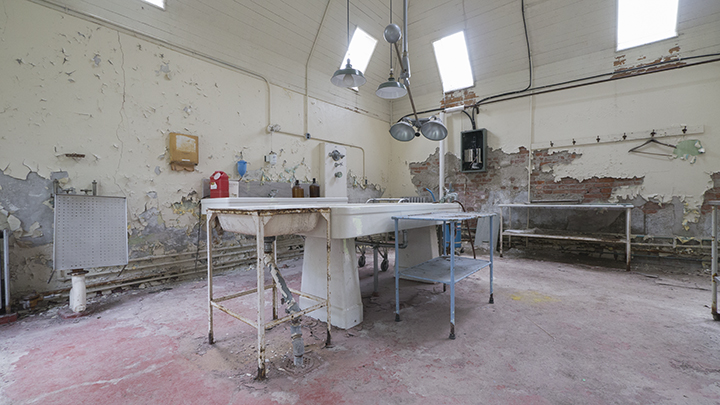
It is really quite a space, and reminds me a bit of the autopsy room at Ellis Island that I photographed a few years ago. After I left the morgue I headed over to Elliot Hall which was built in 1931.

It reminds me of several of the other state hospitals I have visited; long corridors with day rooms at the end of hallways.
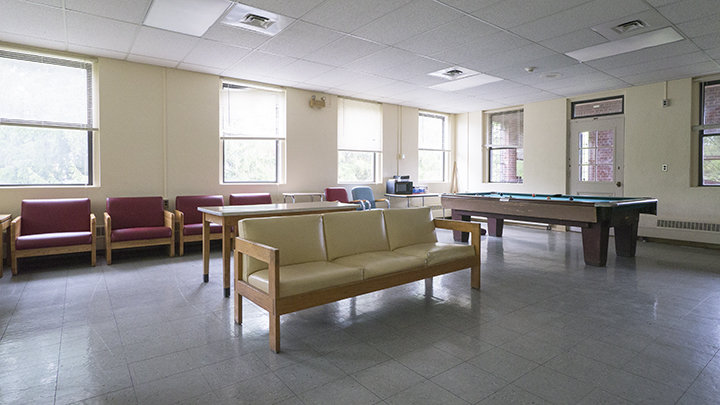
And the stairwells are very similar to ones I have photographed at other institutions.

Before leaving to head home, I stopped by the cemetery where the Willard Cemetery Memorial Project folks arranged this nice remembrance of Lawrence Marek (unfortunately not his real surname) who while a patient at Willard dug over 900 graves for those who died while living at the institution.

The next tour of Willard should take place again next May. It is a great opportunity to meet former staff and see first hand what an amazing place it was, and in many respects, still is.
Willard Open House
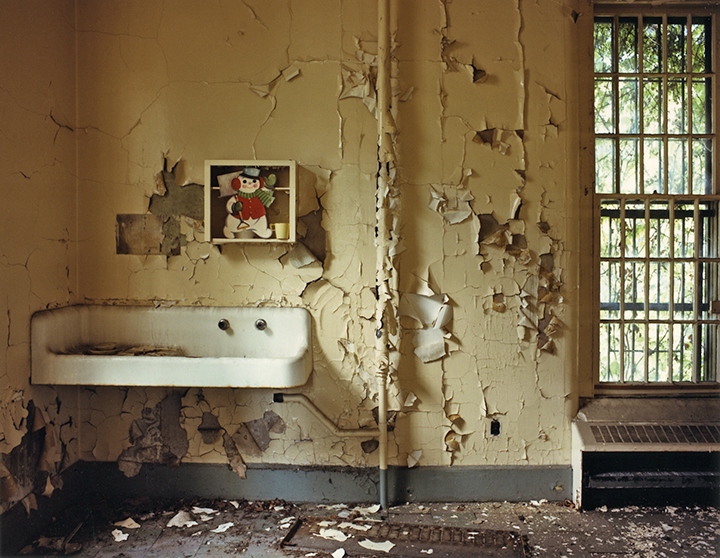
There will be a rare opportunity to see the grounds of Willard next Saturday the 18th May. I have copied and pasted all the information that I have at this point, and you can view it below. I would highly recommend that anyone who is in the area and is interested make the effort to attend. / This photograph is from my first visit to Chapin House after it had been closed for several years.
Willard Psychiatric Hospital WILLARD – Organizers of the guided tours at the former Willard Psychiatric Center on May 18 are trying something new. This year only two starting times are scheduled for tours so visitors will have more of a chance to explore 9 of the structures that grace the landmark hospital on Route 96A.
“We used to have three starting times but people never had enough time to travel through these incredible buildings so we decided to limit it to two,” said organizer Lee Anne Fox. “This will improve the flow of people and give our 35 volunteers the chance for a lunch break.”
The two-and-a-half hour tours are slated to begin promptly at 9:30am and 1pm at the Grandview Building, built in 1860 and now used by the Finger Lakes Federal Credit Union. Other buildings that will be recognized by those familiar with the site, which began its history in 1869 as the New York State Agricultural College, include Brookside, Bleak House, Hadley Hall and the Mortuary.
Current stones in the Willard Cemetery have only a number, and no name.
Current stones in the Willard Cemetery have only a number, and no name.
Former Willard hospital employees and some current staff of the Willard Drug Treatment Campus, which took over the property in 1995, will be available to answer questions and offer background during the event. Some may discuss ghost sightings that have been the subject of television shows. Visitors will also have the chance to inspect the Willard Cemetery where 5,776 Willard patients were buried from 1870 to 2000. An effort has been underway to restore the cemetery, which is adjacent to hospital grounds.
Cost of admission to the tour is $10 per person. Children under 12 years of age are free. Proceeds from the event will benefit the Elizabeth Cady Stanton Child Care Center, an accredited not-for-profit daycare center in the Jackson Building, which once housed Willard’s School of Nursing and is also on the tour. Parking is free.
For additional information contact Carly Hungerford at (607) 869-5533.
The Amazing Beverly Courtwright
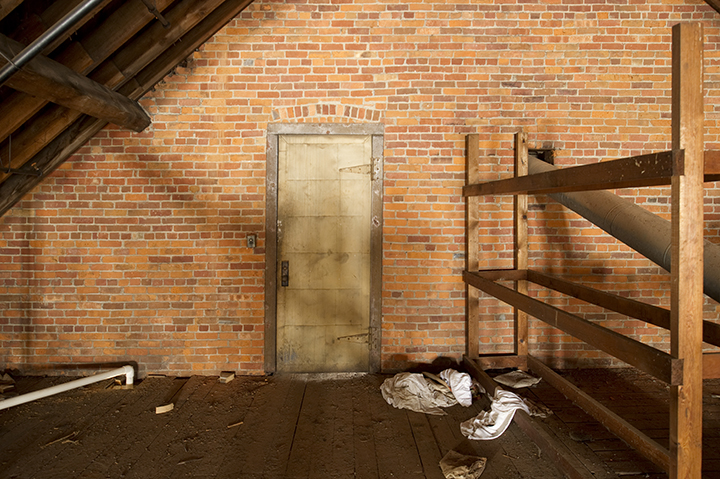
I have always given primary credit to Craig Williams for saving the Willard suitcases, and his contribution to the preservation of these objects was enormous. But if it wasn’t for Beverly Courtwright’s connection to Willard and her tremendous respect for the patients and their lives, the cases would have been lost forever. On Saturday I got the chance to meet her for the first time, and thanks to the corrections folks who now control the site, we were allowed to go into the attic for a few minutes. It is behind this door that in May of 1995 Bev “rediscovered” the cases. She had become one of the Willard employees heavily involved with the transition team responsible for shutting down the psych center. As a storehouse clerk, part of her task was to go through all the buildings to determine what should be saved and what could be thrown out. She described the first time she opened this door and saw the cases stacked up as a surreal experience, and told me that she felt a “whoosh of energy” sweep over her.

She grew up in the area, and as a child remembers Willard patients coming to her home through the Family Care program that allowed for patients not in need of direct care to live temporarily in private homes.
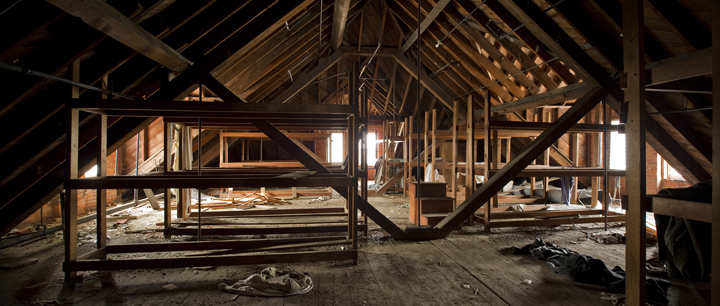
This is what the attic now looks like when you walk through the door. The racks are on either side of the attic with men’s cases on one side and women’s on the other. When Bev was talking about being up here for the first time it literally gave me chills.

You can see the letters on the racks representing the first initial of the surname of each patient. Whomever set up the system did an amazing job. I find it so interesting that as in the residential parts of the buildings, men and women were segregated up here as well.

There were a very few items left behind that could not be linked to a specific patient. This coat was one of them. / As my work on this project continues, I am constantly overwhelmed by the people I meet and the stories that they have to tell. Late last night I got an email letting me know of a new comment on this post. Scroll down toward the bottom of the comments section and read what Stephanie had to say. / Getting into the attic and meeting Bev really tied together everything that I have been trying to say with my work on this project. She is a truly remarkable person with a huge heart and the ability to convey a great sense of connection to the people who were at Willard, and I just want to thank her for all she has done.
Hadley Hall Bowling Alley

On Friday I got the chance to get into Hadley Hall on the site of the former Willard Psychiatric Center. The Romulus Historical Society was setting up the annual display of Willard suitcases and I helped out a bit by moving some boxes around. There were two areas of interest to me, and this post is about the first of those. Hadley Hall was the recreation facility for the asylum and was built in 1892. The building is dominated by a beautiful auditorium complete with a fully functional stage set-up. On the lower level is this bowling alley. According to people I have spoken to, the alley was used by both staff and patients.
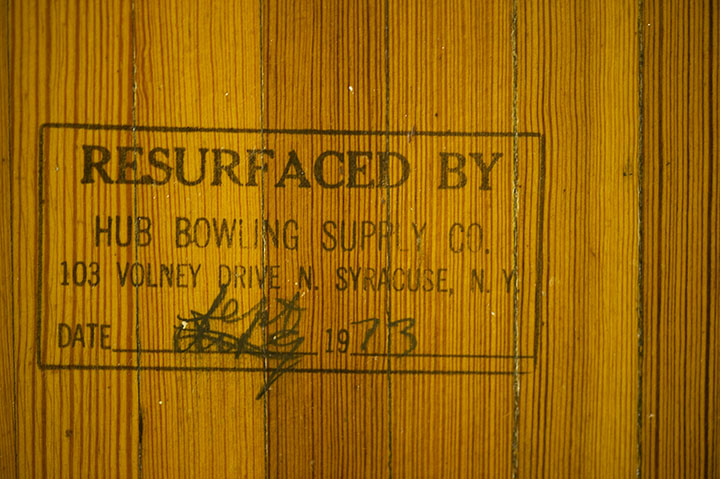
And I believe that the lanes were used up until the psych center closed in the mid 1990s.
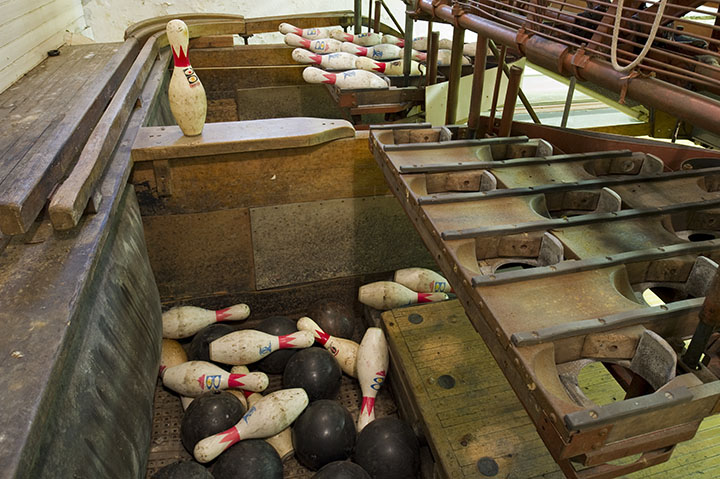
The system for resetting the pins and returning the balls was mechanical only to a degree. Someone back here behind the pins waited for the ball to arrive. It would be returned via the wooden track and the pins would be reset (depending on a strike or spare). The mechanical part of the operation involved the pins being dropped onto the lane once they were loaded onto the mechanism (see below).

When people were bowling, the place must have really been hopping.
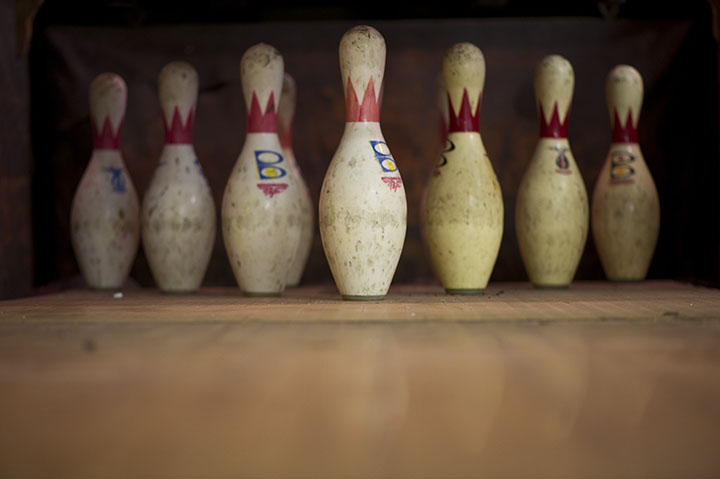
It is so interesting to me that most of the components of the alley were still here and relatively intact.
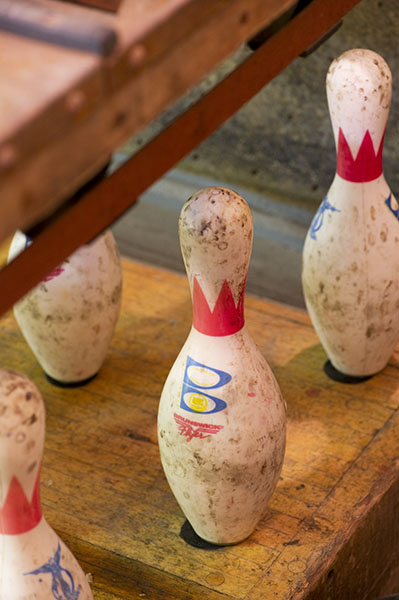
The pins certainly look well used.
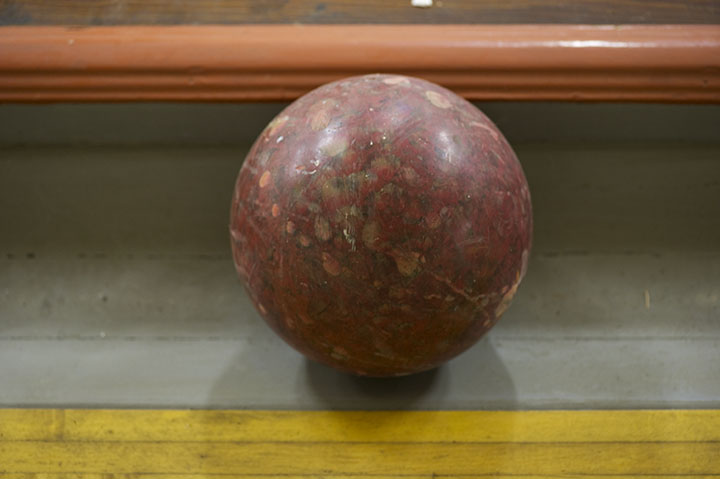
This is a very cool ball.

I am constantly reminded how fortunate I am to have access to these spaces.

Tomorrow I am back in Rotterdam shooting suitcases, but I hope to post part two of my visit to Hadley Hall later in the week.
 Jon Crispin's Notebook
1 comment