Willard Suitcases / Irma M / Print Sales
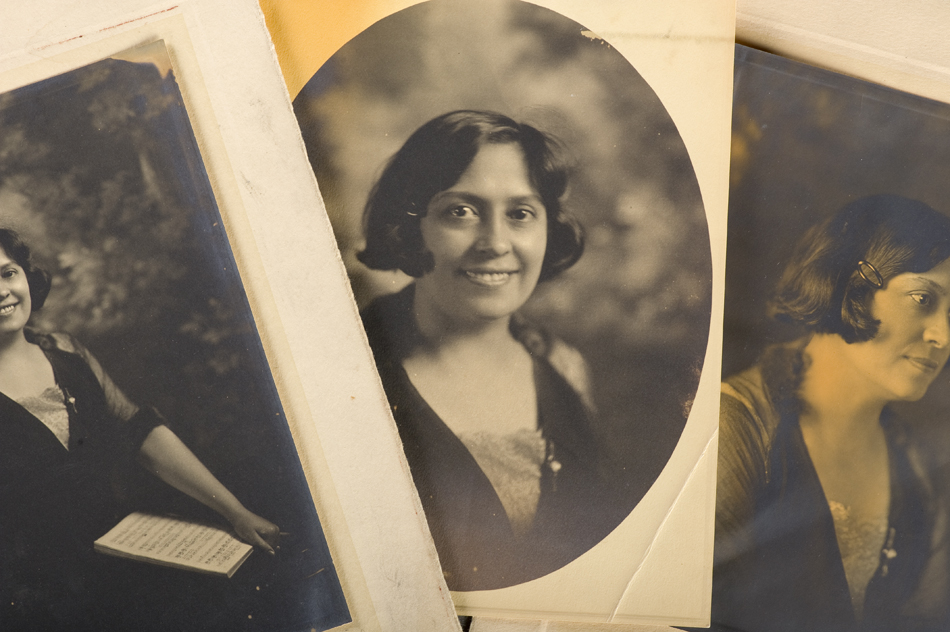
I have spent quite a bit of time over the past few days working on Irma’s photographs in order to upload them to the willardsuitcases.com site. Included in her things were several professionally done portraits of her, as well as many indications of what her life was like before coming to Willard. If you would like to check out the collection, go to the site, then “The Cases”, scroll down to the bottom of the page and you will see her name. Make sure you click on “View: ALL”, so as to see all of the photos. It is well worth having a look.
I have set up the site so that you can order prints from the project. It is a fairly simple procedure. When you click on an image in a collection, you will see an “Add to Cart +” button. Click it and from there you will have 3 sizes from which to choose. Just follow the directions about payment, and I will be notified. I’ll then make the print in my studio, sign it, and ship it off. Couldn’t be easier, and it will help the project tremendously. Thanks so much.
Willard Suitcases / Ovid Talk / Willard Cemetery / Interesting Information
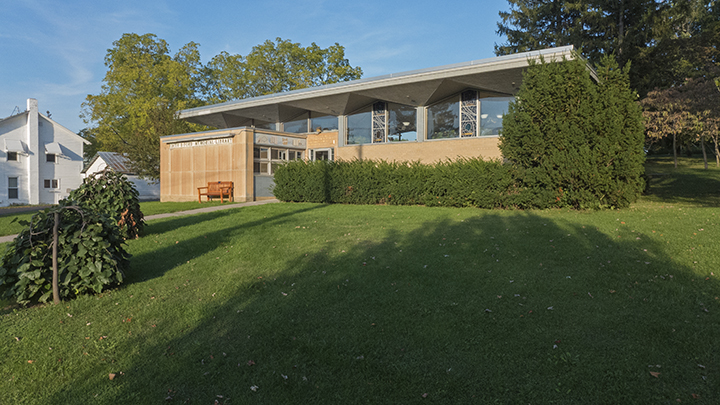
On Thursday, I made the trip from Western Massachusetts to Ovid, NY for my talk about the suitcases. I arrived late in the afternoon and the light was nice on the front of this lovely early 1960s building.

It is so great to see a library from this era that hasn’t been messed up by continuous “updating”.
The crowd of about 50 people who attended the event was fantastic. At the beginning of my talk I asked how many in the audience had been employees at Willard, and up went at least 10 hands. I always learn so much by being able to talk to folks who were intimately connected with the place. In fact, two very important facts came out during the question and answer. The first was that while the patients were at Willard, their suitcases and possessions were kept in storage on the same floor as their rooms. And they absolutely had access to their things. I get asked about this regularly; I think most people who see the project assume that once they came to the institution they were stripped of their belongings, which I now know not to be the case.
The other bit of information that I had never understood has to do with why the suitcases were kept by the institution. When a patient died, the State of New York contacted the families and were given two options. Send money to cover shipping costs or come to Willard and pick up the suitcases. We now know that neither of these things happened to approximately 400 deceased patients, which is why the collection exists today. Amazing. Thanks so much to the wonderful Peggy Ellsworth for clearing this up.
Before the Friday noon brown bag lunch at the library, I had the chance to go to the cemetery and walk around for a bit. It is always something I do when in the area, and connects me to the place in a very real way.

Recently I have been in contact with a nice gentleman who expressed an interest in Frank C. He was concerned that as a veteran, Frank was not accorded the proper respect in his burial. This brought up the subject of the section of the cemetery that contains the headstones of veterans who were patients at Willard. As you can see by the flags, there is someone making sure that this section is well tended. What is most interesting is that this is the only part of the cemetery where the patients are named, and headstones placed over the graves.
I hope to be updating the willardsuitcases.com site quite a bit this week, so check it out if you get the chance. Thanks for following.
Willard Suitcases / Madeline C. / Ovid talk

One of the cool things for me about Madeline’s collection is that she had the negatives for many of her photographs. The museum did a fantastic job in conserving and co-ordinating the negatives with the prints.

When I turned over this particular postcard, I was thrilled to see that she had stayed at the Prince George Hotel in New York City. I have overnighted there twice, and both were memorable. The first time I had just turned 16 and I, along with my friends Jeff, Jay, and Dennis drove to the city from Meadville and were there for a few nights. The other occasion was sometime in the early 1980s. That one got a bit weird.
Tomorrow I drive to Ovid for my talk at the public library. Edith B. Ford Library, 7pm. Hope to see you. I also expect to be there on Friday at noon for a brown bag lunch.
Willard Suitcases / Michael B
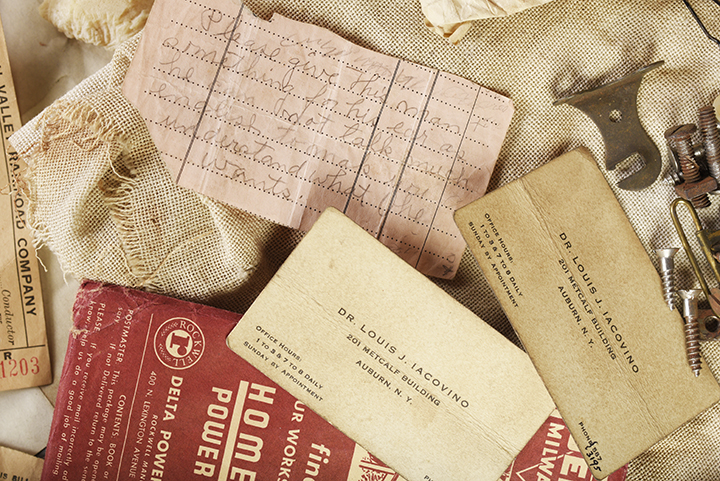
Here is another example of a complication in one’s life that could possibly lead to time spent at Willard. It has not been unusual to find evidence of language problems in the lives of people who were patients there. Obviously, there must have been other factors in Michael’s situation that led him to Willard, but we have never seen such a direct link to language issues. (Michael was born Michele B in Italy.) The pink note should be readable, but if not, here is the text. “Please give this man something for his ear as he can not talk much english [sic] to make you understand what he wants.” Very sad, and I wonder what the writer meant by “something for his ear”. My first thought upon reading this was a reference to the Babel Fish which is featured in Douglas Adam’s Hitchhiker’s Guide series of books.
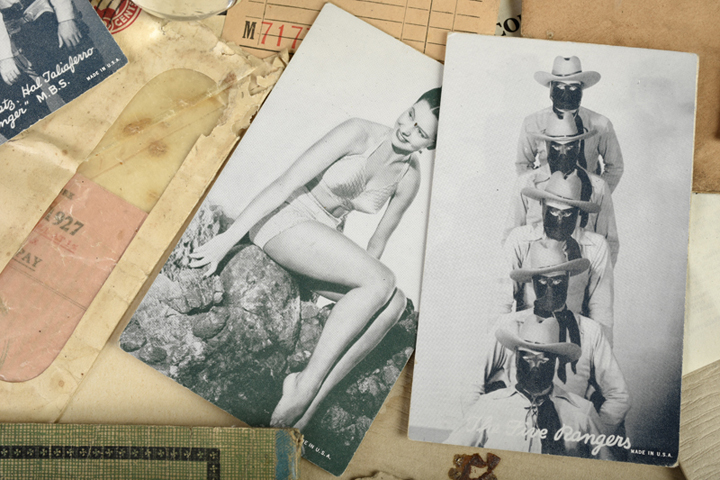 This is also the second case in which we found postcards having to do with the Lone Ranger.
Yesterday, we also photographed Lawrence Mocha’s suitcase. I will do a longer post about him in the next few days.
Thanks for following.
Willard Suitcases / Michael B
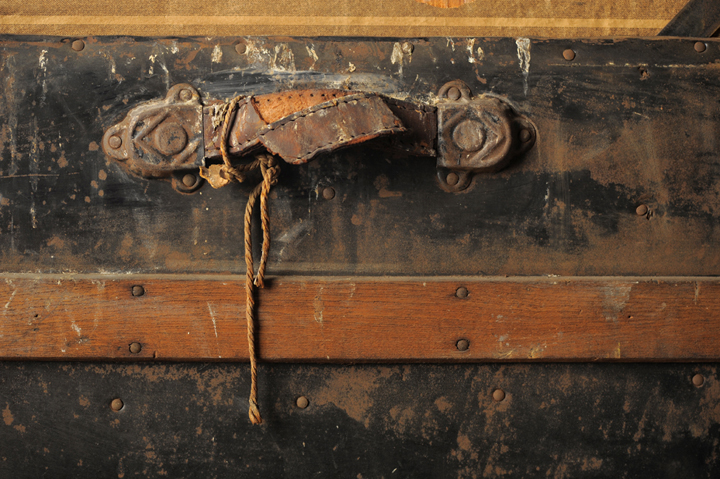
This is what is left of the handle on one side of Michael’s large trunk. Sadly, there is only a tiny remnant of the original Willard tag attached to a string, so there is no information about the date he arrived. But there is a ton of very interesting material in the collection, which I am really looking forward to photographing next Tuesday.
I will be doing a longer post with lots of photos next week. Until then, thanks for following.
Willard Tour / Cemetery / Names / Thoughts – Part 2

It was interesting to me to find out that it was OMH itself that tracked down Lawrence Mocha’s distant relatives. According to Mr. Allen, his office used every means possible to locate Lawrence’s family in order to get permission to release his surname, which in turn allowed his full name to be used on the plaque on the cemetery grounds. In my conversation with Mr Allen, he explicitly said that surnames could be released if a representative of the family could vouch that there was no objection to releasing that name. OMH would send documents that would need to be signed in order to guarantee family acceptance, but as in the case of Lawrence’s family, it would not need to be a direct descendent who signs those papers. (Lawrence did not appear to have any children.) This is a huge development for any family members who seek information about relatives that lived in state Psychiatric Centers. Again, massive credit goes to Colleen Spellecy and her group for getting OMH to move on this. It would be naive for anyone to think that any of this would have ever happened without her hard work. What was especially amazing to me was that towards the end of the ceremony, members of the committee read the actual names of over 100 patients who were buried at Willard. And Colleen has a list of 500 more families that have agreed to the release of names.
After the ceremony I had a very nice chat with Anna Kern, whose father’s mother’s maiden name was Mocha, and if I am correct ,was a cousin of Lawrence. She and her husband travelled from Minnesota to be at the ceremony, and Anna was genuinely moved by the fact that people were acknowledging her long forgotten family member. I was also able to introduce myself to Darby Penny whose work on the suitcases preceded my own access to the collection. It was an interesting conversation, as our goals differ greatly, and I believe we have a fundamental disagreement about the role the state played in the treatment of people with conditions that led them to a life at Willard. I think it is very obvious to anyone who views my work vis a vis hers what those differences are. Darby’s book and site are worth checking out if you want to get an idea of her approach to the suitcases.

I was going to write a bit about my feelings of seeing so much attention focused on Willard, but I think I’ll save it for later, as I am still sorting it all out. But I did want to mention something really great that happened as I was leaving to drive home. Several weeks ago I was contacted by Clarissa B‘s niece Christine. She was moved to get in touch after she stumbled across this site and realized that Clarissa was actually her aunt. Somewhere in the comments on that post, someone wrote that it was a shame that people like Clarissa were forgotten. Chris wanted to correct that idea. What she told me was that even as a patient at Willard, Aunt Clarissa spent quite a lot of time visiting her family, especially during holidays. As a child, Chris enjoyed seeing her, and it was important to her to let people know that she was decidedly not forgotten. So just before getting into my car to head home, I read an email from Chris that she had taken the tour and was herself about to leave. We managed to meet on the side of route 132A and have a lovely conversation.
One last thing I want to mention. I am just a photographer who has been given an incredible opportunity to document the Willard Suitcases. Though I have developed strong opinions about what Willard was all about, I work very hard to separate those feelings from my work as a photographer. Mental illness is a hugely complex issue, and ultimately I have no interest in using my work to make a point about what the state did or didn’t do in regards to the people who lived at Willard. I just hope that my photographs can give a little bit of life back to those folks, and allow them to be defined as something more than just people with a mental illness. Thanks to all of you for following along, and giving me such incredible motivation and support.
Willard Suitcases / Margaret D. / Uniforms
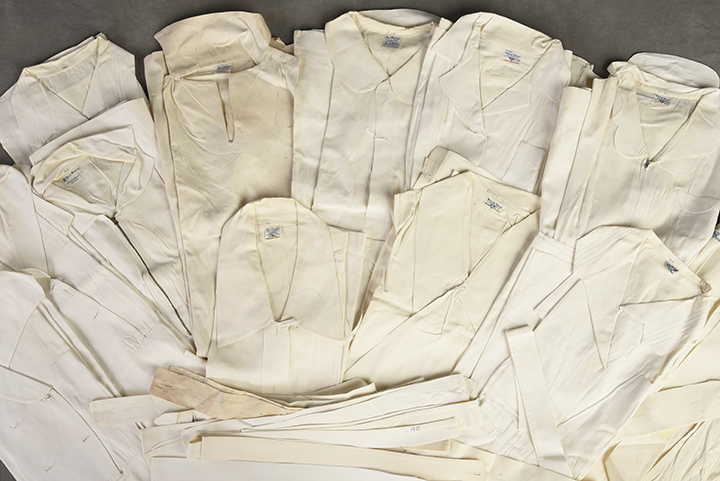
We are still working on Margaret D’s cases. This is the second batch of nursing uniforms that we have photographed. She worked in various hospitals in Upstate New York before coming to Willard as a patient.

All of her things are in good condition, and these garments are all clean and moderately starched.
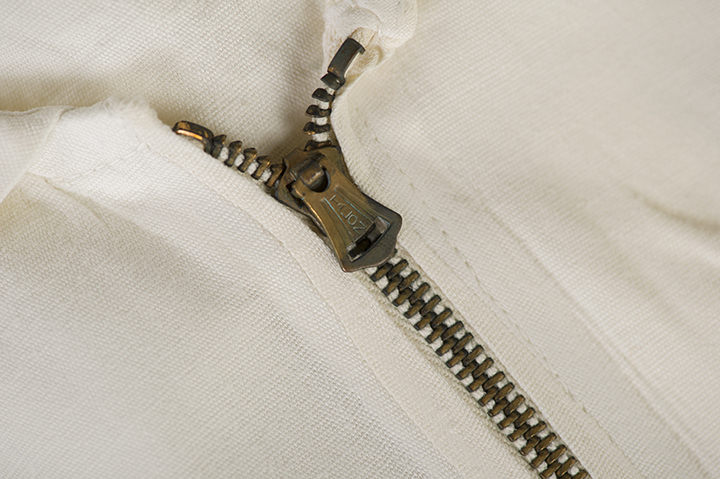
As I grew up in Meadville, PA (home of Talon Zippers!), I always look at any that are in the collection. It was by far the most popular of all zippers throughout most of the 20th Century. Many of my friend’s parents worked for the company.
I leave tomorrow for the open house that takes place at Willard on Saturday. I will be spending time at the cemetery, and hanging out at the Romulus Historical Society building with Peggy Ellsworth, who is a former Willard employee and trustee of the historical society. If you are attending the event, please track me down and introduce yourselves. I hope to see you there.
Willard Suitcases / Margaret D / Update

One of the loveliest aspects of my work on the suitcases is connecting with wonderful, smart, and knowledgable people. After this morning’s post, I received a comment from Dhyan about the photograph. You can read her comment here. (Scroll down to see it.) She seemed to know so much about the subject that I emailed her a full resolution image of this wider shot. Here is her response. I am sure she won’t mind me reprinting it.
Jon, Thanks!!!
I enlarged the picture to 500% and took a really close look at it. Here are some other things I notice.
Top Right: I believe that band was probably done as “draw work” Some of the threads are selectively pulled out and the rest are used to make the patterns using an embroidery thread to hold them in place.
Did you notice how beautifully woven the folded fabric on the right is? You don’t see THAT any more. My grandmothers had some table cloths that looked like that. How they could ever bring themselves to put them on the table with grandkids around is a mystery to me! I do believe they were heavier handed with Clorox in those days!
I noticed at the bottom there is a line that says “Royal Society No 5….” That probably means that she bought this piece of fabric from an embroidery fabric company. Probably the zig zag line was already on the fabric when she bought it but the pattern she would have filled in is above it and probably on other parts of the fabric as well.
The blue edging is crochet. Because the pattern is penciled in or stamped on, I wonder if that was already on the piece when she bought it but maybe not. Still I think I would have done the pattern first and the edging last so maybe it was on there already. She may have been bringing pieces of uncompleted work to do at the asylum.
One more thing. The piece between the blue edging and the left edge piece, that looks like a lace border, maybe the top of a camisole, is tatting. I have actually never seen tatting done but I know you have a kind of spindle that looks a bit like a guitar pick and by going over and under and around the through you make those edgings. Look at the VERY edge that is not crochet which is why I think it is tatting.
The only thing that is a bit bothersome if the green embroidery with the colored flowers. That is not up to the quality of the rest of her work. Wonder what the story is with that?
Anyway, thank you so much for showing it to me. I loved looking at it. People don’t know much about embroidery these days. I once had the opportunity to look at a very, several-hundreds-of-years old embroidered Chinese jacket and spend about an hour pointing out details to the owners. It was silk, Jon, with tinier stitches than I had ever seen.
Anyway, thank you again for a lovely half hour of procrastination! J
Dhyan
Dhyan, I am not sure if you were aware of her history, but Margaret was Scottish by birth and didn’t come to the States until she was a young adult. I would guess that she acquired her skills with the needle before arriving here.
It is a good time for me to thank all of you who are following this project. I really do feel close to those of you who comment, and pay so much attention to this unique collection. Cheers, Jon
Willard Suitcases / Margaret D. / Tour
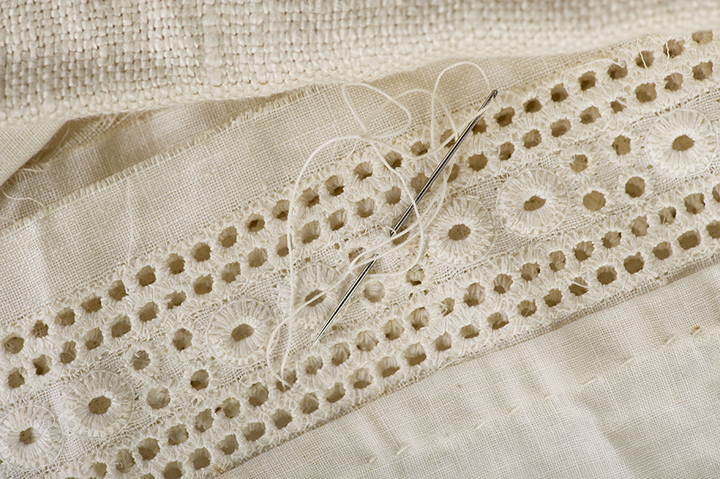
Yesterday Peg noticed some of Margaret D’s handiwork with a needle. And here is one of those needles, still in place where she last used it. I have no idea what this process is called, but it looks quite intricate.
The annual public tour of Willard is on for Saturday the 16th of May. It is a fundraiser for the Elizabeth Cady Stanton Children’s Center. Here is a link to their Facebook page. I would advise getting there very early, as this is a wildly popular event. Tours are run at 9.00 am and 1.00 pm. And if you have never experienced a central New York State chicken bbq, I would advise you to get some tickets for it. Also that day, a memorial service will be held at the cemetery across the street honoring Lawrence Mocha, who as a patient dug many of the graves. That event takes place at 11.00 am and should be interesting.
I will be there for much of the day, and would be most happy if those of you who follow this project would come up and say hello. If former Willard employee Peggy Ellsworth is in charge at the morgue again this year, I will probably hang out with her much of the time.
Willard Tour 2015
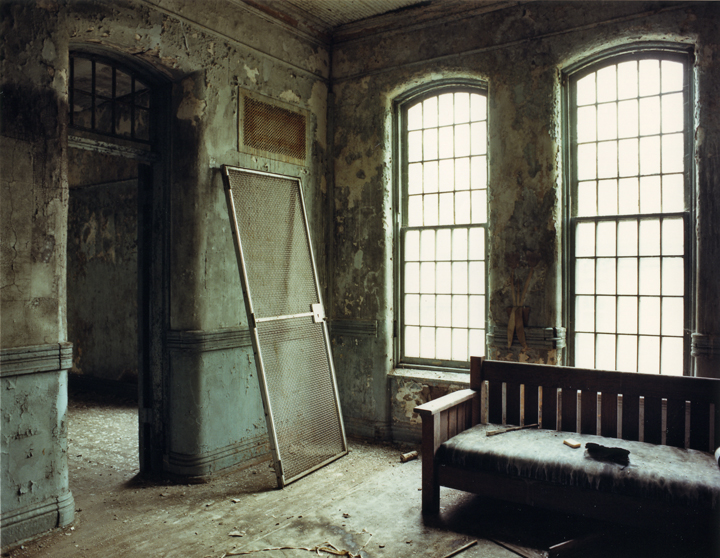
I am often asked about the annual tour of the Willard grounds, and I now have some tentative information about this year’s event. It is a fundraiser for the Elizabeth Cady Stanton Children’s Center, which is on the grounds of the old asylum. Here is a link to their Facebook page, where they will post details. It is tentatively set for the 16th of May. If you plan to attend, get there early as it is usually very crowded.
Additionally, the Willard Cemetery Memorial project is holding an event that same day in honor of Lawrence Mocha. Here is a link to a Finger Lakes Times article that includes some details.
I hope to attend each event, and would be happy to see any of you who can make it. Thanks to Mark for the tip about the Lawrence Mocha event.
The above picture is one I took in May of 1984 on my first visit to photograph inside Chapin House on the Willard grounds.
 Jon Crispin's Notebook
5 comments